Core Concepts: Git for AI Governance
Briefcase AI transforms your AI infrastructure into a Git-like repository. It enables you to manage your AI decisions the way you manage your code. With Briefcase AI, you can build repeatable, atomic, and versioned AI governance operations - from complex policy updates to compliance audits and decision investigations.
Just as Git revolutionized how we manage code changes, Briefcase AI brings version control semantics to AI decision management. Most of these concepts will be familiar to developers:
AI Knowledge Repositories
Like Git repositories contain your codebase, Briefcase AI repositories contain your AI knowledge:
- Prompts & Templates: Versioned prompt engineering artifacts
- Policy Documents: Business rules and compliance guidelines
- Knowledge Bases: RAG embeddings and reference data
- Model Configurations: Hyperparameters and deployment settings
Each repository represents a logical namespace for related AI decision-making components.
Knowledge Commits
Every change to your AI knowledge creates an immutable commit:
- SHA-based Identity: Each commit gets a unique cryptographic hash
- Complete Snapshot: Full state of all knowledge at that point in time
- Audit Trail: Who changed what, when, and why
- Atomic Updates: All-or-nothing changes prevent inconsistent states
Decision Branches
Like Git branches enable parallel development, decision branches enable safe AI experimentation:
- Zero-Copy Branching: Create complete knowledge environments instantly
- Environment Isolation: Test policy changes without affecting production
- Merge Workflows: Controlled promotion from dev → staging → production
- Rollback Safety: Instant revert to any previous knowledge state
Decision Traces
Every AI decision becomes a permanent, auditable record:
- Immutable Snapshots: Complete input/output capture with confidence scores
- Knowledge Linkage: Exact knowledge version that informed the decision
- Replay Capability: Deterministic reconstruction of historical decisions
- Chain of Custody: Full provenance from input to final decision
The Briefcase AI Model
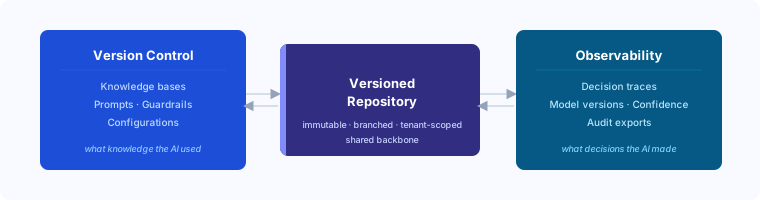
The Briefcase AI model: Version control for AI knowledge + observability for AI decisions, connected through a shared versioned repository.
Key Benefits
Version Control Without Decision Duplication
Since Briefcase AI provides versions of AI knowledge without making copies of data, you can time travel between knowledge states and roll back to the version before policy errors were introduced. With Briefcase AI you can create branches and get a copy of your full production AI knowledge environment, without copying anything.
AI Decision Versioning Capabilities
Borrowing proven abstractions from Git, Briefcase AI lets you create versions of decisions via commits, which in turn belong to branches. Creating a commit is synonymous with creating an auditable decision version.
Git-Like Operations for AI Governance
We created Briefcase AI to provide Git-like capabilities to AI teams. It provides decision version control based on Git semantics, scaled to handle enterprise AI workloads.
Working with Briefcase AI
Just as you interact with Git through familiar commands (git commit, git branch, git merge), Briefcase AI provides intuitive APIs for AI governance operations:
Typical Workflow: Git-Like AI Governance
1. Create Decision Snapshots
# Track AI decisions with versioned context
decision = briefcase_ai.DecisionSnapshot("loan_approval")
decision.add_input(briefcase_ai.Input("application", loan_data, "json"))
decision.add_output(briefcase_ai.Output("decision", "approved", "string"))
2. Store with Version References
# Decisions are linked to exact knowledge versions
storage = briefcase_ai.SqliteBackend.in_memory()
decision_id = storage.save_decision(decision)
3. Query and Replay Historical Decisions
# Deterministic replay of past decisions
decision = storage.get_decision(decision_id)
replay_result = decision.replay()
4. Branch-Based Knowledge Management
# Via LakeFS integration for knowledge versioning
# (Git-like operations at the storage layer)
lakefs_storage = briefcase_ai.LakeFSBackend(config)
branch_ref = lakefs_storage.create_branch("policy-update-v2", "main")
SDK Integration - "Git Commands for AI"
Python SDK (briefcase_ai)
import briefcase_ai

# Initialize the platform
briefcase_ai.init()

# Create a decision snapshot
decision = briefcase_ai.DecisionSnapshot("loan_approval")
decision.add_input(briefcase_ai.Input("application", loan_data, "json"))

output = briefcase_ai.Output("decision", "approved", "string")
output.with_confidence(0.92)
decision.add_output(output)

# Store with versioned context
storage = briefcase_ai.SqliteBackend.in_memory()
decision_id = storage.save_decision(decision)
JavaScript/TypeScript (WASM)
import { init, JsDecisionSnapshot, JsInput, JsOutput, JsMemoryStorage } from "briefcase-wasm";

await init();
const decision = new JsDecisionSnapshot("fraud_detection");
decision.addInput(new JsInput("transaction", txData, "json"));
decision.addOutput(new JsOutput("risk_score", "0.85", "float"));

const storage = new JsMemoryStorage();
const id = storage.save_decision(decision);
REST API
# Create decision
POST /api/v1/decisions
{
  "function_name": "kyc_verification",
  "inputs": [{"value": "customer_data", "type": "json"}],
  "outputs": [{"value": "verified", "type": "string", "confidence": 0.98}]
}

# Replay decision
POST /api/v1/replay/{decision_id}
{
  "mode": "strict",
  "validate_schema": true
}